Sunday, December 23, 2012

Honest Reflection

The sky was a illuminated dark blue flecked with silver stars and grey raspy clouds. The wind was a gentle breeze, cooling my hair and surrounding me with the invisible feeling of God.

This is what our training group called an "I can't believe I'm in Kenya" moment.

It would be a moment, never planned, never pined for, and never ever precipitated, where we would pull our heads out from our blinders and realize for a second, how free we were in a land where you can see forever, where the nights are still innocent from the pink haze I remember from the DC twilight, and where there is nothing to idealize, because it's there.

And I think that's where the problem started.

Right now, I have been nursing a "I dislike Kenya" phase. It all stemmed from the fact that "I can't believe I'm not in America". When you are in a different land, you go through the honey moon phase if you're lucky, and think everything is wonderful, and eventually, you stop thinking so because you realize that the only thing you can compare your life here with, is to the good parts of your life back in America.

Rather than wondering about random zebras and giraffes loitering along the Mombasa-Nairobi road, we tended to miss our cheeseburgers, internet, and work mentality.


But isn't that why I escaped in the first place? To get away from the obesity that is arguably plaguing the American spirit? From the addictive additives, the mindless cruising in cyber space, to working in cubicles, I joined the Peace Corps to get away from it, and now I need to get away from that feeling inside my own heart.

I won't disparage the American way here, because every volunteer will tell you how much she or he appreciated the ingenuity and hard work put in on a daily basis from the people of our nation, but I won't disparage Kenya by comparing the country to the land of my birth.

I actually don't enjoy safaris or travelling to see different scopes, I know I shouldn't limit myself by not exploring, but in being true to my own nature, what I do enjoy is breathing and living in the fact that what I do matters.
I eat food that from the soil and does not have high fructose corn syrup, I might not get a lot of it, but even in that struggle I'm learning. I don't have a smart phone and am comforted with the fact that when I speak to someone, they aren't burying their face into facebook for about 30% of the conversation at least. And when I work, it has to do with trying to better the lives of people. I can honestly tell you the number of people I've helped teach water sanitation, educate about HIV, and I can show the scars on my hand from using a shovel, hoe, and machete to clear the dam. It beats anything I've done back at home.


This is my life, and if I go around this land and still think it's not as good as home, than I think I'm losing the point of the fact that
"I'm in Kenya", and I better believe it.

Tuesday, December 11, 2012

What Drives Us Further

Self efficacy, imagination, and the agency to act.
I told myself I wouldn't post until the work at Latta Dam was done, failure or success.
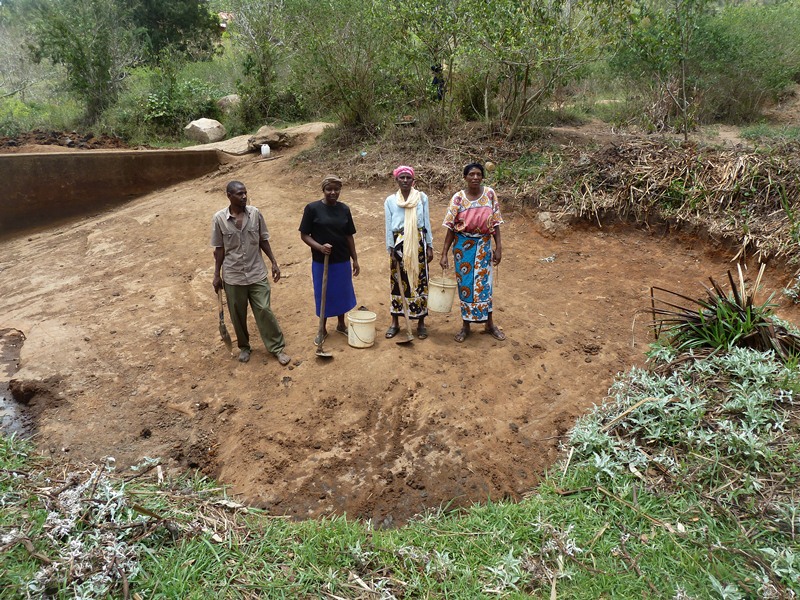
I can wow you (maybe) with this


From this

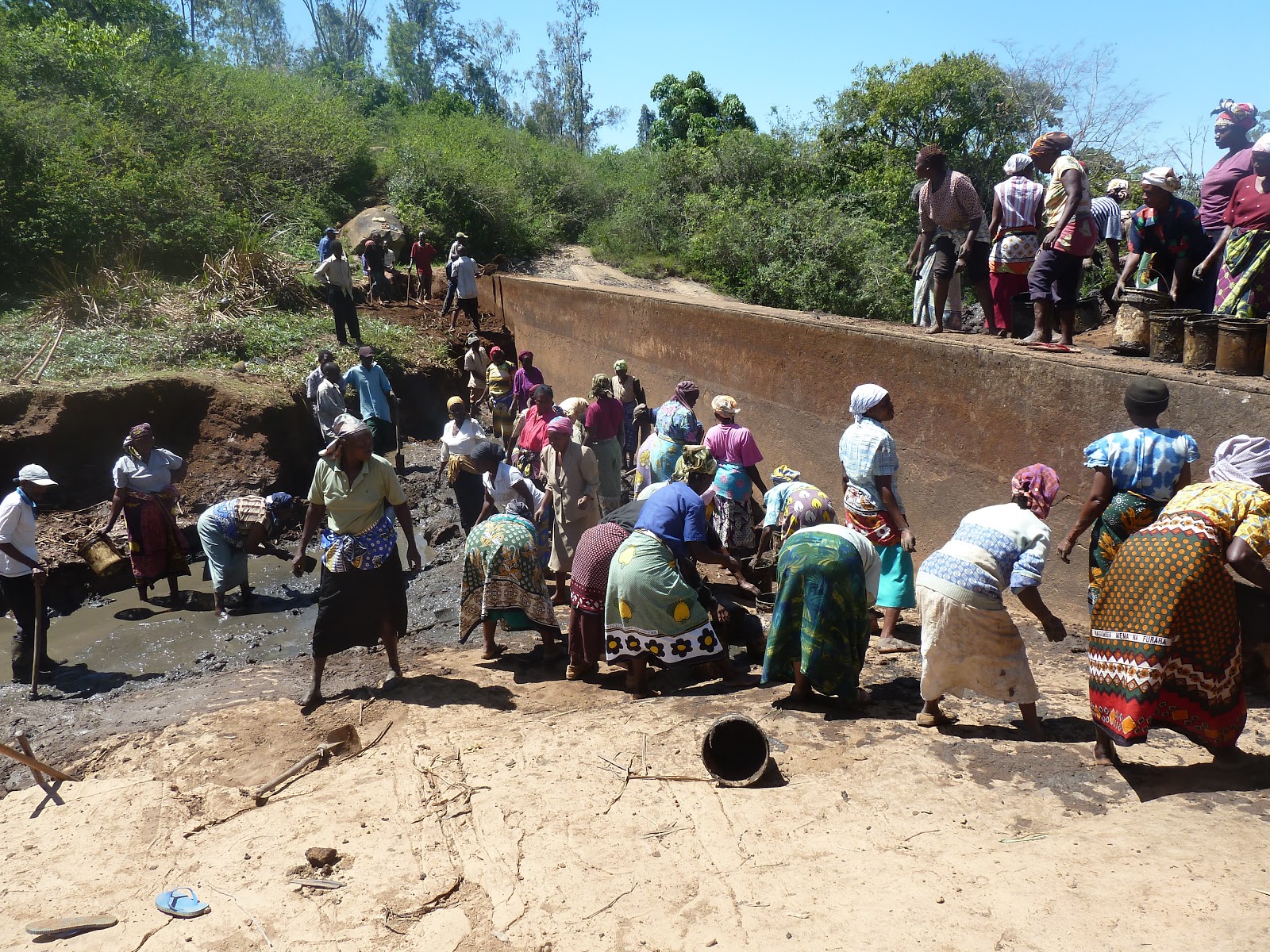
With dirt higher than 7 feet, we accomplished more than any person in Sagalla has done on the dam in more than 30 years. We cleared a dam for irrigation. So that when the rains dry up, we'll have this

But the story, as usual in development, is so much more complicated.

 Since mid September, I worked about 3-5 days a week breaking, shoveling, and removing by bucket dirt with a group of Community Health Workers (CHWs). The work was hard, exhausting (I never had enough water to drink, I can't imagine what it was for the health workers), and dirty. I thought this project would take one month, but instead, it took three.


The idea was for the health workers to clear the dam so that they would have enough water for the rainy season, they would in short, restore the purpose of a dam built more than 50 years ago (which was not maintained because of lack of any technical knowledge).

But the difference between my idea and your idea is that ultimately, we are coming from different directions.


A community health worker is ultimately a volunteer who decides to help the community by being trained in health awareness and outreach. It's a fascinating concept that empowers people who are normally uneducated to help their own community.
It works

 But what doesn't work is when NGOs come in and basically offer free money to the community and more importantly, free ideas.
My counterpart is a brilliant man. He works so hard for the betterment of the community and secured a grant for this land for the CHWs, but the CHWs themselves, because they did not feel the cost of the dam, felt like they couldn't clear the dam without an excavator, without Worldvision to give food for aid. In fact, APHIA Plus (US AID) even paid them 200 shillings every time they came.
But after 2 months, no one came.
Everyone stopped, blaming it on the rain that hardly came and more importantly, that the work was too hard.
In between the work, sometimes 4, 3, or even no one came especially on days where APHIA Plus was holding farming seminars (which included paying participants).
It broke my heart partly.
When you can paid to do work for yourself, why even try?
A part of me wanted the project to fail to feel the consequence of not working hard enough as a group. Because the CHWs stopped coming after they got up to this

 And then I stopped coming, what was the point? Why try if I'm the only one, another outsider giving assistance when no one necessarily asked?
And then Worldvision stepped in, offering free food if villagers work, and all of a sudden, participation went from this
To this

Incentives are wonderful things, but I know for a fact that here, when the incentive is the only picture, the overall purpose, self reliance in irrigation, has lost its full purpose.
However, what type of person would I be when I saw how much work has been done do to another NGO's money that I'd still desire to want the project to fail.
No, as I've learned here, you have to work with what you're given.
And when I feel tired beyond measure
I climb to the top in the rain and thank God for how far I've come
My dad told me the important of self efficacy, of belief in yourself, and I've realized I haven't for such a long time. And now I know I am good enough for this world, not in competition with humanity, but just a part of and willing to be the best I can be. When agents of Development fund people "for their own good", slowly bit by bit, one cannot compete with free resources that they did not strive for. Then truly, one will believe that they need someone else to do it for them.
I now know imagination matters too. The simple process of having a vision beyond the physical reality of barren dry soil and doing something more. My counter part has that vision and that's why this work happened. Though I completely understand what it means to own your own project. When you are just working hard for something but not sure why you are doing it, when it's not your idea or your plan, how much are you moving forward as a person?
And finally, I've said this before, the agency to act. It's one thing to have belief and vision, but if you don't do it, don't take the energy to get up and stand, then what's next? NGOs promote agency through money, money does not buy development, it's not different than dictation and colonization.
I now know in Kenya, that it's important to be okay with the way of life here, I'm not here to fight it, just understand it, and be so grateful that I'm learning.
Thanks Dad. Seriously, I love you

Thursday, September 20, 2012

Why I love Islam in this modern era

As we were climbing up the hills back to Sagalla, wind in our faces, cleaving dust into our eyes, somewhere among the countless turns and passes by larger trucks and vehicles, I looked into the stars.
Stars as wondrous as reality intended, unfaded by lack of artificial light, clear as only a mountain view can afford.
I thought "If I were to die right now, by some freak turn of events, this would be the last memory embedded in my heart"
And then I thought of our beloved Prophet, Peace be upon him, and how the entirety of the Quran was lodged in his heart, and how those passages kept him company even as he awaited every man's fate.

"La Ilahah, Illalahu, Muhamadur Rasoolilah"
"There is no God but Allah, and Muhammad is His Messenger"

That was the first thing lodged in my heart at that moment, as the cold air swept my face, and it hit me as physically as the gust.
The Prophet represents the best in us, for we are just as human.
For there is truth, God, and then there is a human, Muhammad, worthy to be His Messenger.
We too can have the Quran in our heart.
Along with it sayings such as

"Because God will never change the Grace which He has bestowed on a people until they change what is in their own soul: and verily God is He Who hears and knows all things" Surah 8, verse 53

"To each is a goal to which God turns him; then strive together (as in a race) toward all that is good. Wheresoever you are, God will bring you together. For God has power over all things" Surah 2, verse 148.

How is that not a blessing, when you are at your last breath, you can recall such verses in your heart, and because they are in your heart, they become a feeling.
A feeling from God.


Do you remember that God taught the Prophet Adam "the names of all things", the ability to understand the world for what it is.
Do you remember when the Prophet Abraham was deciding what he should worship? He wanted to worship the moon, sun, stars. But then he realized things for what they were, physical phenomena, and that is not the entirety of God.
Do you remember how God told us, when we die "That God may reward them (the doers of good) according to the best of their deeds..." Surah 24, verse 28. We will literally shine from the good we do, from the sparks in our hearts.
This is why I love being a Muslim in the modern world.

A world where these is reason, acceptance of science, and sadly, much need of love. For that I love the words in my heart, I love knowing that the sky is as beautiful as my life is fleeting. I love knowing that even if that is the truth, spending the few moments of my time loving makes this test bearable.
I love knowing that I must deserve Heaven, not expect it, though I know I am worthy.

I love knowing that my heart was broken the day Ambassador Chris Stevens died.


He was a volunteer as well, in Morocco, before his time in the Foreign Service. He taught children English, little boys and little girls. He did God's work because he was a human being that cared. And he died of smoke inhalation, which is basically burning from the inside out. That was his fate.
His pain, this is the pain that a few can bring when they take advantage of a situation.

Is that the love that was from our Prophet, is that Islam since its inception?


"Muhammad is no more than a Messenger: many were the Messengers that passed away before him. If he died or were slain, will you turn your back on your heels? If any did turn back on his heels, not the least harm will he do to God: but God (on the other hand will swiftly reward those who (serve Him) with gratitude." Surah 3, verse 144.


He had the words of God in his heart, and like any other Messenger, he warrants respect, not for being an otherworldly being, but for being one of us, and still standing for what is good. Now, do we turn back our heels? No.

"From whensoever you start forth, turn your face in the direction of the Sacred Mosque; that is indeed the truth from your lord. And God is not unmindful of what you do". Surah 2, verse 149.

My friends, I love  Islam in the modern times because this is a time of reason, science, and a need for empathy. Empathy for our friends, our community, and the people who are so emotionally broke that they  use guns and explosives to show their pain. We are the Muslims who know one need not be Muslim to listen to God, and that one may not listen to God even if he is Muslim.
Let's rectify that, bit by bit, within our own lives. We can do it by putting more of God's words in our heart, turning it into feelings of love, and letting those feelings out to our fellow brothers and sisters.

Show them the Rope that we hold onto so dearly.
God bless you and I love you all. 

Monday, September 17, 2012

Fear of Development


You know,
I'm a hypocrite.


This is my current profile picture, but I actually really hate it. It gives the impression that I was teaching the 50+ CHWs how to make the "Kibongoro Cheoga Vala" (Kisagalla for "Handwashing Container").
But in reality, though I did talk about using it. For the most part, I was very, very adamant that a Community Health Worker and fellow Sagallan teach his peers. In fact, the picture below was the reality.


That's CHW Frank, he knows how to play guitar, carries a Bible that has the cover depicting Jesus fighting sinners like an action star, and he's been super kind to me.
He trained them, and with his teaching, the hospital staff taught about why it's important to use it.
While no CHW used the handwashing station before, after his demonstration, the work of the staff, and the naming of the station as a Sagallan invention. This happened.


25+ people washed their hands, about 50 were trained that day


I really am afraid of NGOs and foreigners like myself. We come to Kenya, and on a larger scale Africa, with technical expertise from our parts of the world and assume that by imposing it on the community, we are helping them. By telling them "through our help, you will succeed", we believe that we are developing.
But I don't believe that's  development,  it's neo colonization.
And not just money, not just donating schools, dams, food, you're also spreading ideas.
Ideas that don't come from the community, ideas that leads to dependency.

We do it for good intentions, but here is the result, you give a people things without telling them how to use it, or why they should even need to use it, you create an atmosphere where they will either
1. Believe they can't live a good life without outside help
2. Not know how to sustain your gifts after the money runs out or the dam malfunctions
3. Not even bother with your gift because they never needed it in the first place
4. This is the worst, be screwed over because the infrastructure set up to provide an income for them (such as maybe rabbit farming) collapses after your organization leaves.

So that's why I'm afraid sometimes, that's why I hate that picture, and that's why I'm a hypocrite.

But I'm happy
Because I know that now, after being here, and am grateful God gave me this experience..

The Quran states that the greatest charity is one where the giver takes no credit. And in this world where I blog, email, call, people will know what I do, but if I can leave Sagalla after two years and be known "as that Mzungo who was around, but I'm not sure what he did", but in reality, helped teach others to convince their neighbors to wash their hands, or to use condoms. Meaning that I was able to assist without the Sagallan people thinking they were helped by a foreigner (because they empowered themselves). I think that wouldn't be terrible.
 I don't know, I thought about this a lot, and guys, I just don't want to be that person who just brags about the work he does, because that is not the human being I want to become. No, I want to be Muslim, or try to be at least, and that is not a knock on other people or faiths, but it's time I just practice what I profess right?

Lot's of love,
Tanim

Thursday, September 6, 2012

Knife in the moonlight


In the backyard of my fenced in compound, even the bright moonlight is quenched by the ferocity of clouds, incensed by the same wind that shakes the trees around me.

Tonight, with nothing but the wild passerby dogs and the darkness keeping me company, I whisper
the names of God, I only know 3 of the 99, not enough, but it's something that fuels me.

These howling nights, I shiver in fear, fear of the unknown, fear of being useless, fear of being alone.

But I keep on reciting, I recite Surah Al-Fatiha, I start whispering the names again.
Then slowly, in my temperate trance, I feel my heart beating more than blood into my veins.
I feel everything right itself within me and I leap into a stance. Left arm and foot pointed forward, I sense an enemy come at me with a left hook, I block with my left  and throw a right footed front kick into his thigh and lean in for the right knee jab.
I spin a 180 and block another aggressor coming in and jab his neck and then...and then
I blink, realizing I didn't follow through at the empty space before me, at the nothingness that I've been fighting each night.


Here in Kenya, when people stare at you because of the way you look, when everything is new and difficult, how do you tell who you are versus who you think you're supposed to be. What makes you real my friends? How many projects have I heard about and how many of them will I be able to finish before my term here is done. Any?

That's hardly even half of my site

You see friends, I practice fighting imaginary enemies at night to stay sane in the day time for work.

Because, when I do martial arts, I know myself. When I recite the verses of my religion, I think of a higher power that to me, is always there no matter where I am. And when I realize I didn't follow through, it's just another sign that I need to concentrate harder.

So that when I wake up, feeling stronger and more in tune, I can work my best.

These moments are a knife in the moonlight, a flash in the blur of stars in the sky.
Such random strokes of violence are my ways of being at peace with this forever.

Wednesday, September 5, 2012

Tilling in Sagalla

You know those simple facts about your life that you never really thought about...or ever?

Well here are some obvious facts I knew

Fact: I have no idea what the difference between a leek and spinach plant is

Fact: Most people in Sagalla are farmers

Fact: Nikitaka kujaribu kusaidia watu ya sagalla, ninafaa kujifunza ambayo watua ya Sagalla ku.fanya kazi.
If I want to try to help the people of Sagalla, I must learn what the people of Sagalla do for work.

So when a group of ladies challenged me to go work with them at their little farm (called shamba), this was the second time someone asked me and I said no because I was wearing khakis. But I said I would return. And I did (with jeans)

I picked up the rake and started to learn how to till the land. I know my Dad, who will read this, will just laugh considering how many times I passed up or overslept the opportunity to help him (I attribute this to my own fault in character, no excuses).

But, as I felt the blisters in my hands grow and plowed on literally throughout the day with this woman, whose name is Vigilance (no joke), I began to realize.

My grandfather was a farmer, and in his village in Bangladesh, people do this. The people of my culture do this even now. My blood is connected to this.

Of course that didn't make me an expert, but it did make me feel astounded to this fact.

In America, many of us have no idea how to grow a basic plant, even though just a few generations before hand that's what many of our grandparents did.

To learn so that we may work. I guess this is step one.

On a separate note: Some things I am looking forward to
1. Meeting the chief hopefully tomorrow
2. Friday: Tim Kibet, my superior in the Peace Corps may come to visit
3. Saturday: Out reach program
4. Sunday: Continue my travels around the area (I submitted some pictures for you see my surveying)
5.  Monday: Meeting and recap with my counterpart
6. Tuesday: A meeting about traditional birth versus hospital births
7. Wednesday: Meeting with our HIV support group
8. Thursday: Feedback meeting with the Community Health Workers
9. Friday: Visiting a beehive fence!
10. Saturday: Street Cleaning with a youth group and then watching them play soccer

Here are some things I have done

1. Helped pass out over 650 bed nets during one of the distribution dates
2. Showed over 140 people a video on HIV made by PCV Lorenzo Nava
3. Met with a Polytechnic school to discuss possible activities involving sanitary pads and health education
4. Learned how to cook pasta (basic but whatever okay!)


At one of the high points of Sagalla
The hospital where we work at

The skies here are so close you'd think if I was taller...

Monday, August 20, 2012

First few days in Sagalla


I arrived to Sagalla last Thursday with my counterpart/supervisor (considering the supervisor on paper, who is on leave, would prefer me to work with my counterpart, who in turn has a lot of responsibility on his own.
My counterpart's name is Godrick Machofe, whose last name actually means beer because his grandfather used to run a brewery. He is always busy working as a prevention outreach specialist and basically the only CHEW in an area where there is 76 CHWs.
Sagalla is divided into 8 villages, with the biggest geographical divide being Upper Sagalla, which is on top of these giant hills which are basically mountains to a flat land native like me (I'm from a very plain town in New Jersey), and Lower Sagalla, which is bellow the hills. While both suffer from lack of water and crop failure, it is Lower Sagalla that bears the worst of it, being attacked regularly by elephants and having no medical facility (it takes a half an hour by matatu to get from the level 3 center where we are situated in to the lower lands, and that's down hill).
I've been reading the Community Mobilization book given to me by the Peace Corps and have identified together with Machofe a goal that he has long been working on and noticed that the CHWs have been focusing on too. While HIV in the youth remains, based on my interviews with CHWs and Machofe's assessment, there is a serious need for food that isn't government hand outs (I'll get into more detail on that in a second). Much of this is because water shortages and lack of market has wiped out any ability for people to be able to feed themselves properly. As Machofe pointed out, handing out ARVs to people living with AIDS is only half the battle if they can't even have a nutritious meal. There is no market here, in fact, finding a bottle of water at a duka is a lucky feat I have found out (though of course soda is abundant, go figure). So our goal is

1. Empower every individual to take care of their own ability to feed themselves.

To do that, will take more research, but it helps to identify some problems, I'll go into further detail throughout this email. Again, if you got to this point of the email, my thanks and I appreciate it.
On Friday, I met with all 76 CHWs and observed their latest endeavor, I am proud to say that I was able to greet and introduce myself in Kiswahili (as well as say a few Kisagalla greetings). They have worked with a member of the Ministry of Agriculture (and coincidentally, the architect of the fruit free grafting project at Wildlife Works in Maungu) to create the foundation for about 25 lemon-mango graft seedlings, as well as natural plants such as bluegum. A graft is where they cut a piece of one tree into the roots of another, so that the strength of a lemon tree root is added to a fruit tree such as mangos. The ultimate goal is to create a resource center where farmers within Sagalla can learn and produce their own types of trees and learn of sustainable agriculture techniques, so that they may feed themselves and sell their produce. Because there is no market day here in Sagalla, that's a long term goal (in order to have a market day, you need something to sell and someone else willing to buy it). Unfortunately, it takes about 150 shillings matatu to get to the nearest market, which is Voi, so many can't really afford that, and walking up and down takes a lot of energy, and how many people can afford that when they are putting so much energy to meek out a meager existance?

As for the challenges of the inception of the shamba (farm), it is situated underneath a dam built by a missionary in the early 20th century. Unfortunately, no one was taught how to take care of the dam so much of it has been not maintained and every year, a giant pile of silt blocks water from going through the fields. As a result, what used to be a water pipe going to the lower lands has been blocked by the government because there is not enough for upper lands. Every year, World vision does a "food for work" program, which Machofe dislikes because when the program finishes, no one will have enough investment when the food runs out, and of course, this is the first year, that the program is not running to get rid of the silt. So now the silt needs to be removed within a month. The cultural theme here seems to be that they are waiting for money to pay machines to remove it, or for the government, or for anyone else with resources to do it for them. But Machofe (and I, though I don't like to put my idea so blatently when I just arrived), think maybe we can do it ourselves, we have the manpower, we have the shovels, and we certainly do enough time (just barely).
On Saturday, we went to a program initiated by our Level 3 Health Center called Outreach. As I have mentioned earlier, it's extremely difficult to get to the Health Center from Lower Sagalla, so the nurses and Machofe go to them with vaccines, HIV tests, and prenatal care. I counted at least 30 women, 6 men, and 40 children, which apparently was a slow day because another organization was handing out food aid (again, another theme here). 
I met more people who have said they have problems with elephant raids and it allowed me to research something I found out about Sagalla last month. Apparently, there was a scientist who discovered that an active way to get prevent elephants from raiding crops (and as such, from retaliation by farmers), was to construct relatively inexpensive (relatively) bee hive fences. The elephants, who would be stung in the nose and eyes, were effectively dettered by the bees, and the farmers had a secondary source of income through the honey. Apparently, this scientist, Dr. Kelly, made two fences a few years ago, and made plans in 2011 to construct five more. I contacted the person from the ministry of Agriculture for his input, as well as one CHW who is neighbors with one person with the bee hive fence. I want to research more (and have already gathered materials on the construction of bee hive fences as well as bee hive keeping, which the community was long looking into here) and will have a meeting this Saturday after work on the shamba to see the plausibility. Again, I have to work hard to make sure I'm not just putting my own idea in front of the community, it's so important that I don't let pride get in the way of being a volunteer whose goal is to volunteer into the work of the community, not just give work to the community.
Yesterday, Machofe told me of his idea to have an International AIDS day so we went to Rule 2 in the Community Mobilization book and started breaking down the Target Community to 
1. Youth in Schools
2. Churches
3. Married Couples, which can be broken down to
3a. Women's outreach
3b. Mens outreach (trickier)
4. Farmers (which is tied to 3a. and 3b.

As for 1 and 2, Machofe loved the videos Lorenzo gave us prior to him COSing, and I suggested finding a way to make a movie night for the youth, and playing the UKIMWI video during intermission to educate. So that's a possibility. The nurses at my facility also enjoyed the videos and wanted a copy as well. The cell phone versions were very popular too. Thank God for Lorenzo, who spent is last year as a PCV making them.

A lot ideas in this short of time is a warning to slow down. Rome wasn't built in a day, and I'm neither a builder nor Romulus (and hopefully not Remus), I'm here to serve and as such, have told the people here to use me more like library where I can provided information, and have made a point in saying that I do not have money. As for grants, I will definitely wait longer before I even think about them so that I have a better idea of. And I should start thinking of my needs assessment.

But as for living situation, I believe my room will be ready today, it's a two room building with electricity, though no running water. My bed frame will be ready today, and my couch, two chairs tomorrow. I will buy a two burner gas stove tomorrow as well. The chujio, which although at first leaked at the spout, is now working well thanks to the help of William, the hospital daytime watchman.  I'm better at ideas, though now I must be better at just learning how to live on my own, such as learning to properly cook, clean, and maintain my own room. I am grateful for my co workers of Sagalla for allowing me to stay in the former storage room of the kitchen, it is clean and safe from bugs, and provides me a way to communicate with people at night before I go to sleep (everyone else lives in the dispensary here). I think my point of calm is giving myself some luxury when I go to my room, my father said I should spend some of the money I brought with me here to give myself some convenience. So I might buy a refrigerator. It's not because I need one, but the idea of every man's home is his castle (which I learned from reading about Jagger's assistant in "Great Expectations"), appeals to me as my base. Now to figure out and start reading the Needs Assessment guide.


Talk to you when I do.
God bless you,
Tanim Awwal
PCV Stationed in Sagalla

Biggest Challenge so far: Transportation, matatus are far and between, and getting a bicycle to go up hills here is also a hard task to contemplate. Ah well, that is the pride of a volunteer, to grow stronger.